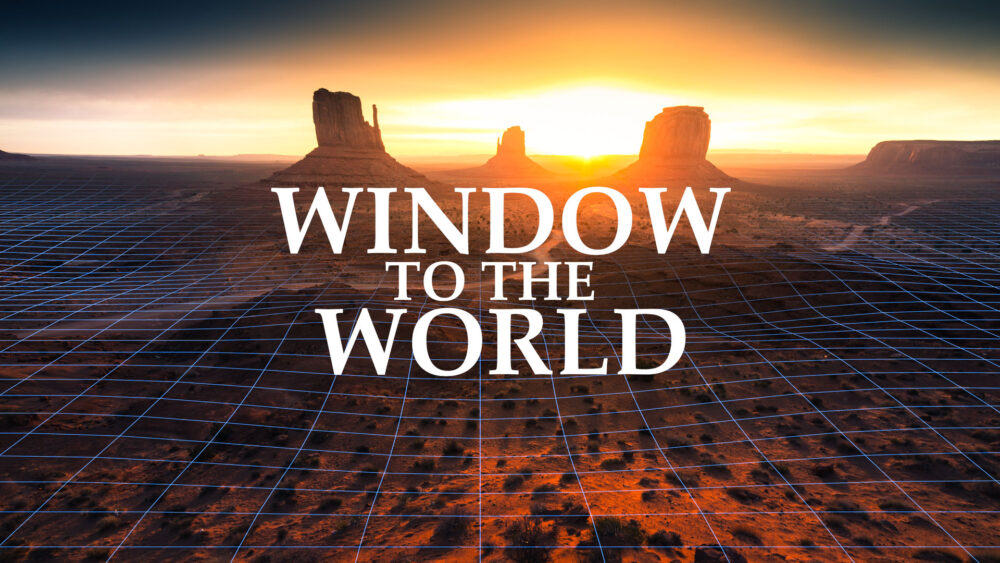
Exactly ten years ago, I decided to make a virtual reality application. I did not know Unity. I did not know C#. I learned enough of both in approximately two weeks and built Window to the World—to the best of my knowledge, the first Romanian VR application released on a public app store. The application is still listed on the Meta Store: https://www.meta.com/experiences/window-to-the-world/977682772321493/ But the project did not begin with VR. It began years earlier with photography and a simple frustration: a photograph could preserve light, colour, composition and detail, but it could not fully preserve the physical sensation of being there.
Photography Without a Drone
In 2013, I started experimenting with ways of giving my photographs depth and movement. I did not own a drone, and consumer drones were not yet ordinary photographic tools. If I wanted a camera movement through one of my landscapes, I could not simply return to Iceland, France or Bulgaria and fly through the scene. So I tried to reconstruct that movement from the photograph itself. I separated the images into elements, recreated the areas hidden behind foreground objects, built approximate geometry in 3ds Max, projected the original photographs onto it and added reflections, displacement, animated water and camera movement. It was not the usual two-dimensional parallax effect made from a few flat layers. The photographs became limited three-dimensional environments. They still worked only within a restricted range of movement, but inside that range the camera existed in something closer to an actual space. I documented the process here: https://aurelm.com/2013/12/15/fernweh-3d-parallax-photography-tutorial/
DYSTALGIA lets you travel infinitely deeper into an image while preserving the meaning of the original scene.
Traditional upscalers enlarge existing pixels. DYSTALGIA does something fundamentally different: it studies the selected crop together with the complete original image, understands their semantic relationship, and generates a plausible new layer of visual detail.
The result can become the starting point for another crop, another generation, and another zoom. This process can continue indefinitely.
It is not just image upscaling. It is context-aware exploration through latent space.
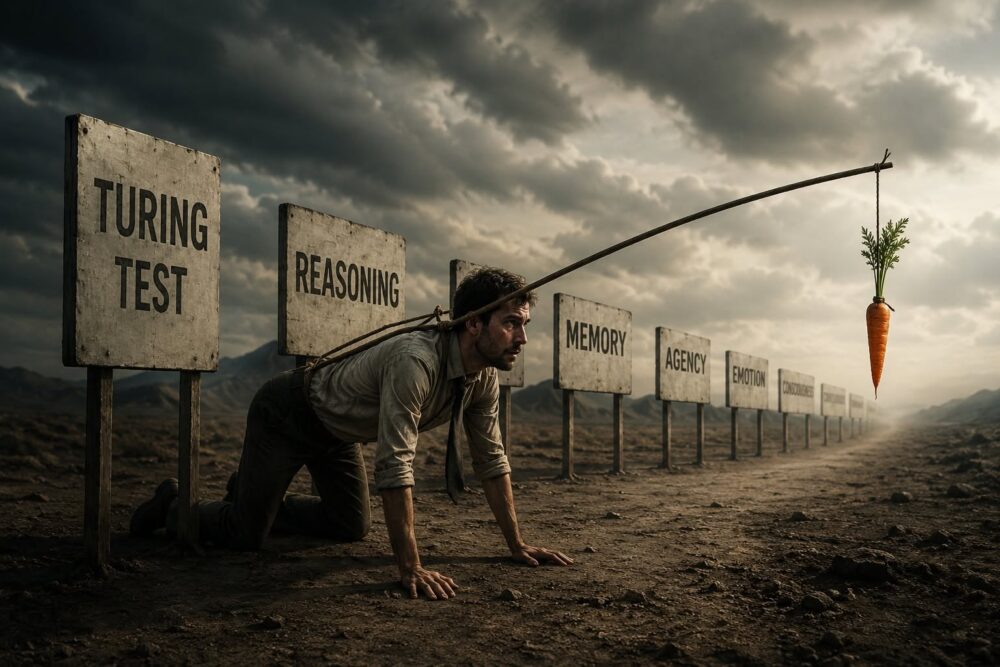
Ani la rand ne-am spus o poveste foarte clara. “Cand un AI va putea purta o conversatie imposibil de distins de cea a unui om, atunci vom fi ajuns la ceva cu adevarat important.” Acesta era Testul Turing. Nu era un meme. Era unul dintre fundamentele domeniului.
Apoi am ajuns acolo.
Si, aproape instantaneu, criteriul n-a mai contat. Nu pentru ca fusese demonstrat fals, ci pentru ca nu ne-a convenit rezultatul.
Am mutat borna.
“Nu, trebuie sa rationeze.” A inceput sa rationeze.
“Nu, trebuie sa aiba memorie.” Acum are.
“Nu, trebuie sa fie autonom.” Au aparut agenti autonomi.
“Nu, trebuie sa inteleaga.” “Nu, trebuie sa aiba emotii.” “Nu, trebuie sa aiba constiinta.” “Nu, trebuie sa aiba experienta subiectiva.”
We’ve had infinite zooms, recursive img2img, outpainting and endless upscaling for years. They all eventually hit the same wall: the deeper you zoom, the less the model understands what it is looking at. It stops seeing an eagle’s eye and starts seeing a brown circle with random textures. Consistency slowly disappears and the generated details become generic noise.
The problem isn’t image quality.
The problem is semantics.
If you’ve read my previous articles, you’ll probably notice a recurring theme. Whether I was talking about infinite scene generation, consistent comics, prompt randomization or Krea 2 workflows, I kept coming back to the same conclusion:
Semantic understanding is far more important than pixel similarity.
A few days ago I published an article about a workflow capable of generating an effectively infinite number of consistent scene images using nothing more than a text description. The central idea was surprisingly simple: instead of maintaining consistency by carrying visual information from one generation to the next through LoRAs, ControlNet, reference images, edit models or image-to-image workflows, I continuously regenerated the description of the world itself. The previous image stopped being the source of truth. The description became the source of truth.
Made in ComfyUI using only local models (and uncensored of course). workflow and usage is the one on this post, with reference actors that seem to work quite well or this direct link to the workflow . embedded workflows and prompts in each asset (basically the whole related output folder from comfy). Models used : LTX 2.5 for Video and 2 shots with WAN 2.2 (explossions ones, at this LTX sux) Flux Klein for images, IndexTTS for voice, Audio Ace Step 1.5 for music
LTX-2.3 is now out with better coherence both temporal and spatial. So I gave it a spin. With a hard sure-to-fail scenario. A very long continous action scene with actor and environment referencing. I know the characters change faces during the video but this is my fault as I updated the characters during the creation of the video.
In my previous posts I talked about how you can use LTX-2 as an WAN upscaler/refiner and how to add external actors and elements references without img2vid (you need an empty scene without them and need them to come into the scene). But why not both ? LTX-2 sux in action sequences and human interactions so the alternative at this point is wan 2.2 . But wan is lowres and has the same issue as ltx, no way for now to add actors in latent space. So I used the same technique as for LTX2 to add actors to wan and then reinforce them in LTX-2 using the same method. Here are some results:
Idea : Generate a very low res wan 2.2 video as reference for LTX but still pre-appending the actors and elements images at the beginning of the video,, then have the first image from the actual shot and referencing the characters from the beginning in the video. This step at 480P is very fast and good enough for characters interaction/movement coherence etc to be used as vid2vid in ltx-2. We save it at 12 fps so we can upscale with temporal upscaler in ltx. Then in the LTX step we bring the same intro images but at highest resolution possible so ltx knows how the characters actually look like in maximum detail and paints them over the lowres wan video at at a 4x resolution. So the 480p video becomes 1440p in this case (but you can go lower if you don’t have the resources, I have an 3090 and 64GB system ram). Both qwen image edit and flux klein were used for generating the actors, scene, zoom ins on the scene, removing characters etc.
I have had a lot of fun with LTX 2 but for a lot of usecases it is useless for me. for example this usecase where I could not get anything proper with LTX no matter how much I tried (mild nudity):
In fiecare zi afli cate ceva nou despre lume sau despre tine. Ieri am avut unul din acele momente de „aaaaah, deci asta era”. Nu am si nici nu am avut vreodata capacitatea de a forma imagini mentale. Prima oara cand am avut un sentiment ca ceva e in neregula a fost in copilarie cand incercam sa folosesc metoda numaratului oilor, precum mentioneaza si primul dintre articole. Pur si simplu nu reuseam sa vizualizez asta si mai mult ma frustram decat sa ma odihnesc. Mai apoi m-a deranjat atunci cand incercam sa desenez si ma loveam de imposibilitatea amintirii unui chip uman. Imi puteam aduce aminte trasaturi, proprietati si sentimente si astea erau mai mult adjective imaginare. Nimic consistent si nimic precum o imagine. Acest lucru se manifesta si acum dar l-am ignorat crezand ca asa trebuie sa stea lucrurile. Nu conteaza daca e vorba de parinti, prieteni buni sau locuri, ceva ce aduce macar a imagine lipseste cu desavarsire . Stiu ca pare ciudat ca cineva a carui principal domeniu este vizual insa dupa cum am aflat nu e chiar asa neobisnuit.
Cand eram mic de multe ori stateam intins pe acoperisul casei la bunici si ma holbam ore in sir la stele. Eram fascinat de imenistatea universului, de misterul care se ascunde in spatele covorului nesfarsit de puncte mici si stralucitoare. Mi-am pastrat fascinatia respectiva si e unul din motivele pentru care viata mea a decurs cum a decurs.
Cand m-am facut mai mare mi-am luat prima luneta, era o chestie de 3 milioane din pavilionul H, lentila frontala 50mm, nimic extraordinar dar a fost prima oara cand am distins cu ochiul liber silueta lui Saturn si mi-am satisfacut o mare curiozitate din copilarie. Mai tarziu m-am apucat de fotografie, am lasat luneta deoparte si am inceput sa explorez lumea prin prisma obiectivului. Apoi am trecut prin perioada psihedelicelor si am explorat universul prin perspectiva universului insusi. Apoi mi-am luat si un microscop si am explorat lumea sub-milimetrica.Read More
Note: This document is written one year ago and is not 100% up to date. A modified (and more technical) version was presented at GDC 2014 by Romain Sididris and it is the main technique used in Modern Combat 5. For those of you with GDC Vault access the presentation is here .
At the time it was I think the only game that used SSAO on a tablet or phone.Read More
I usually don’t write about something else than photography, but this time I feel is somehow my duty. As you know I work in the gaming industry. As an industry, it has little margin for something that is unsure to sell, something experimental, something more art oriented rather than existing bad recipes. So basically “the industry” only manufactures the same existing games over and over, with the same compromises made for accessibility and mass-market, the same action packed brainless, soulless, kitschy pieces of shit. Of course there are exceptions even in the high budget area with some developers taking huge risks to push onto the market games that have potential not to sell. Sometimes they make it, most of the time they don’t. And it’s a real pity since gaming platforms have the potential to push art to a new evolutionary step through interactivity, where the viewer becomes a part of the art piece. And that can be the one and only final step in modern arts, it cannot go beyond total immersion, it can only evolve around this idea along with technological evolution.